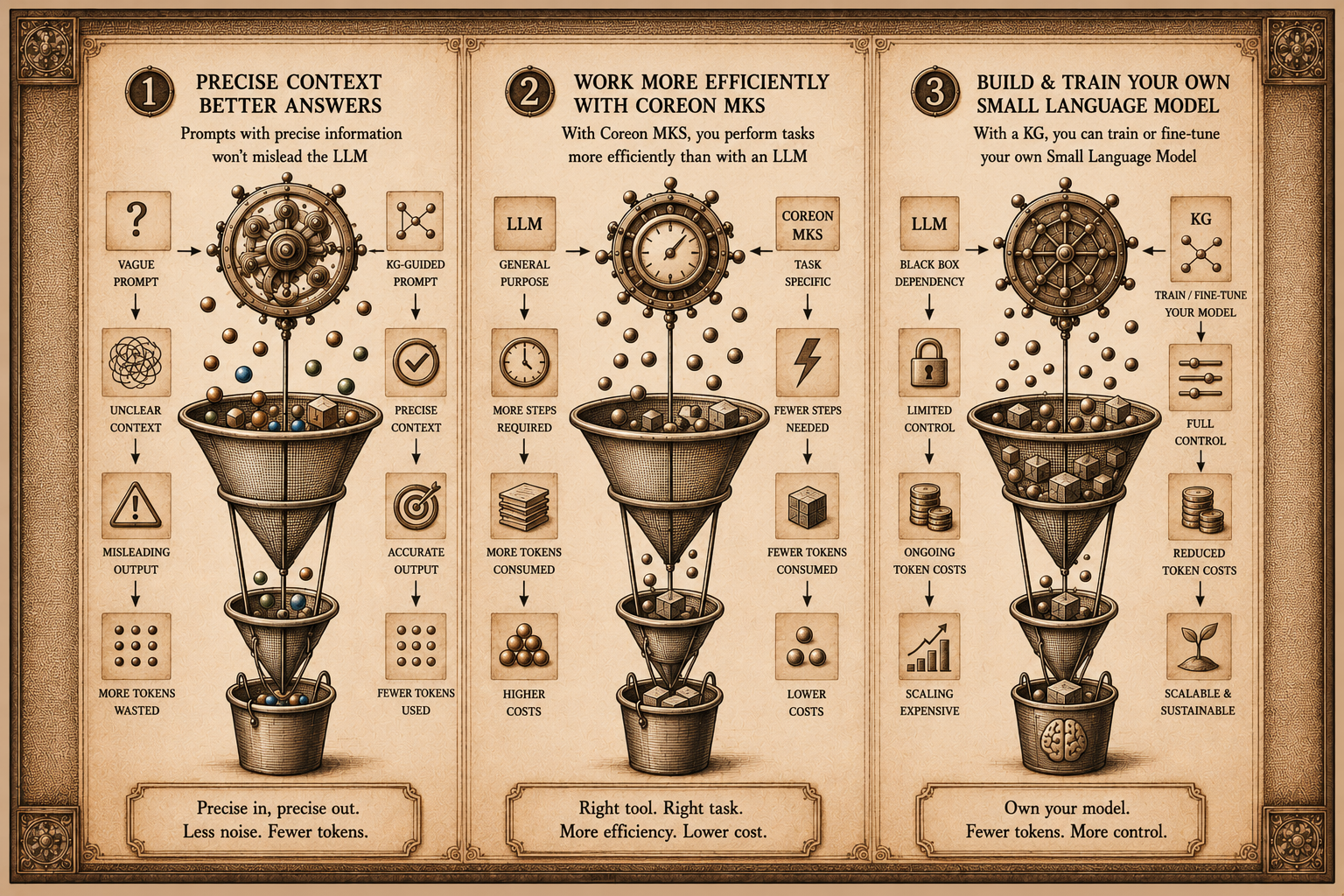

1. Prompts with precise information won’t mislead the LLM
With all terms anchored in a Knowledge Graph, the LLM knows precisely what you are referring to – whether you’re prompting it with the right terms, you’re feeding parts of the graph, or both.
Say you’re working with the term “cell” in a technical project. Without context, an LLM has no way of knowing whether you mean a battery cell, a biological cell, or a prison cell – three completely different meanings, different translations in most target languages. A prompt like “Translate: The cell must be replaced every two years” will likely get you a plausible-sounding but wrong answer. You’ll only catch the error on review, costing you a second round of prompting, thus tokens, to correct it.
With a Knowledge Graph behind you, the word “cell” is already disambiguated as a concept: cell (battery), linked to its domain (energy storage/electronics), its approved translations across languages, and its relationships to neighboring concepts like “battery pack” or “cell voltage.” You feed the LLM that concept ID or its domain path directly, and it translates correctly on the first pass: no clarifying question, no re-prompt, no wasted tokens spent explaining what you meant.
There’s no room for ambiguity or misunderstandings, and you don’t have to prompt again and again to clarify the meaning.
2. With Coreon MKS, you perform tasks more efficiently than with an LLM
New tools out there promise to build a glossary or enterprise vocabularies for you from your existing documents – with the help of an LLM. What they don’t mention: building a glossary this way is costly token-wise, especially at scale, and token costs are expected to remain a real budget line for years to come as document volumes grow.
With the Coreon MKS, you don’t need tokens, and you don’t only get a glossary, but also a graph – all the concepts and their connections mapped out in a systematic hierarchical structure. Coreon provides two services for this, one of which runs without per-token LLM calls: the Annotation Service, which lets you upload documents and automatically annotates the most important concepts. The cost doesn’t scale with the size of your document set the way an LLM-based extraction pipeline would.
3. With a KG, you can train or fine-tune your own Small Language Model
You work with large amounts of sensitive data that mustn’t be sent to external clouds? Then you’ve probably thought about using a Small Language Model (SLM). SLMs use far fewer parameters than LLMs, making them feasible to train and host in environments such as a single computer.
Combining an SLM with a Knowledge Graph leads to a highly domain-specific model that is exactly tailored to your needs. It doesn’t need to “know everything,” just your domain, and the Knowledge Graph supplies that structure directly rather than relying on the model to infer it from raw text. Some researchers even report fewer hallucinations compared to general-purpose LLMs, since the model’s outputs stay anchored to a defined, curated set of concepts rather than drifting toward statistically plausible but incorrect associations.