Product

Multilingual Knowledge Graph
Develop and Discover Semantic Structures.
Taxonomies, thesauri, classifications, nomenclatures, ontologies – in Coreon you manage such semantic structures in a very intuitive, most visual way. Through its concept-oriented approach it inherently supports multilingual views – you manage only one knowledge graph while covering all languages.
In Coreon the semantic expressiveness goes beyond simple broader-narrower relations: Distinguish how concepts are related to their parent concepts. Make evident that one children concept has a ‘generic’ broader relation whereas another concept has an ‘is-part-of’ or an ‘is-instance-of’ broader relation. Group concepts into sections to keep control over larger maps.
VIsual Experience
Language Agnostic

Discovery
Navigate the broader/narrower relations as well as along any type of associative, see-also links.

USAbility
Toggle the orientation
Toggle from top-down to left-right to accommodate the layout of your structures – they may be rather flat or rather deep.
Useful in Daily Life:
- Breadcrumbs: Know where you are in the hierarchy of nodes in the graph.
- Group concepts and branches: Structure large graphs and concept systems into sections and subsections
- Aliases: Reuse a concept at distinct places, even in the same visualised map.
Multiple Inheritance
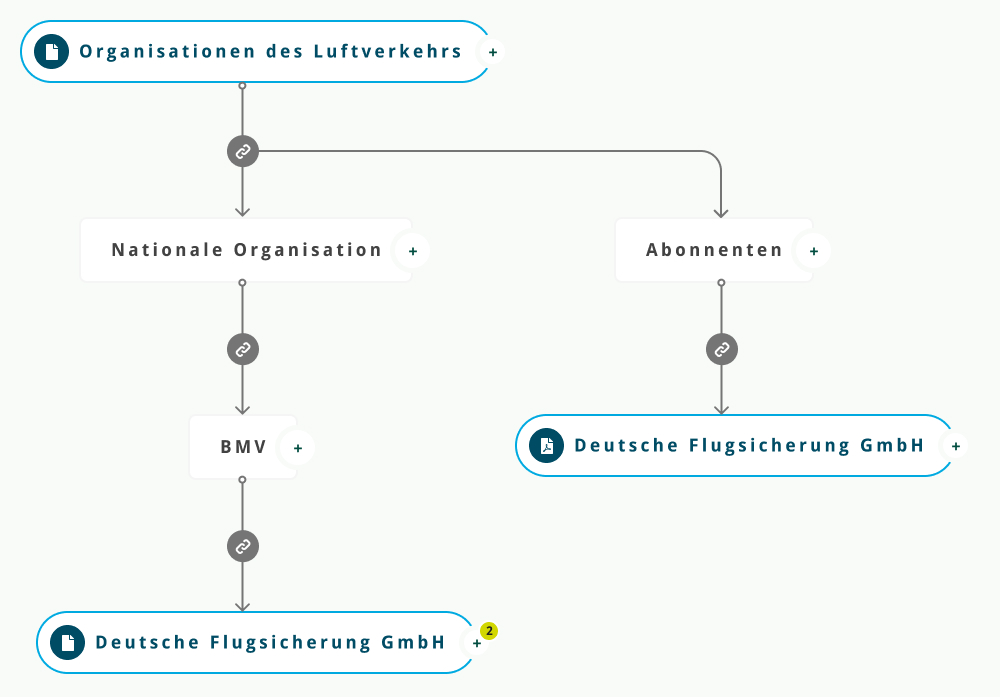
“File” a node under multiple parent nodes to appropriately reflect its semantic facts. Coreon maps are rendered like a tree, but technically they are even powerful graphs.

Aliases let you show the same concept in several places in your knowledge graph, even within one graph. A component can appear under its technical category and in the product assembly where it’s used. Because every alias points to the same concept, its terms, translations and metadata are maintained once and stay consistent everywhere.
SKOS is a subset of the data model that Coreon comes with. For instance, SKOS has no fields/elements for linguistic attributes such as term type, part of speech, or gender. Further, SKOS only models unspecific broader/narrower as well as associative relations. Coreon, however, can differentiate between partitive or instance-of broader/narrower relations as well as custom, semantically more meaningful associative relations. Therefore, supporting, i.e. importing/exporting SKOS always requires a mapping to best benefit from Coreon. We have years of experience in such SKOS -> Coreon -> SKOS transformations and are happy to adapt SKOS for your repository. Through its SPARQL API and Linked Data support, other semantic web applications can query and link to the data stored in Coreon.