What is a Context Graph?
Some people on LinkedIn have been using Context Graph (CG) as a synonym for Knowledge Graph (KG). However, that’s not quite accurate. While CGs and KGs share some common traits — after all, both are graph-based structures that connect entities via typed relations and support reasoning — they serve fundamentally different purposes.
KGs model static concepts: entities, types, and relationships that describe what is generally true about the world. CGs, on the other hand, model events, decisions, and chains of actions — in other words, what happened, in what order, and under which circumstances.
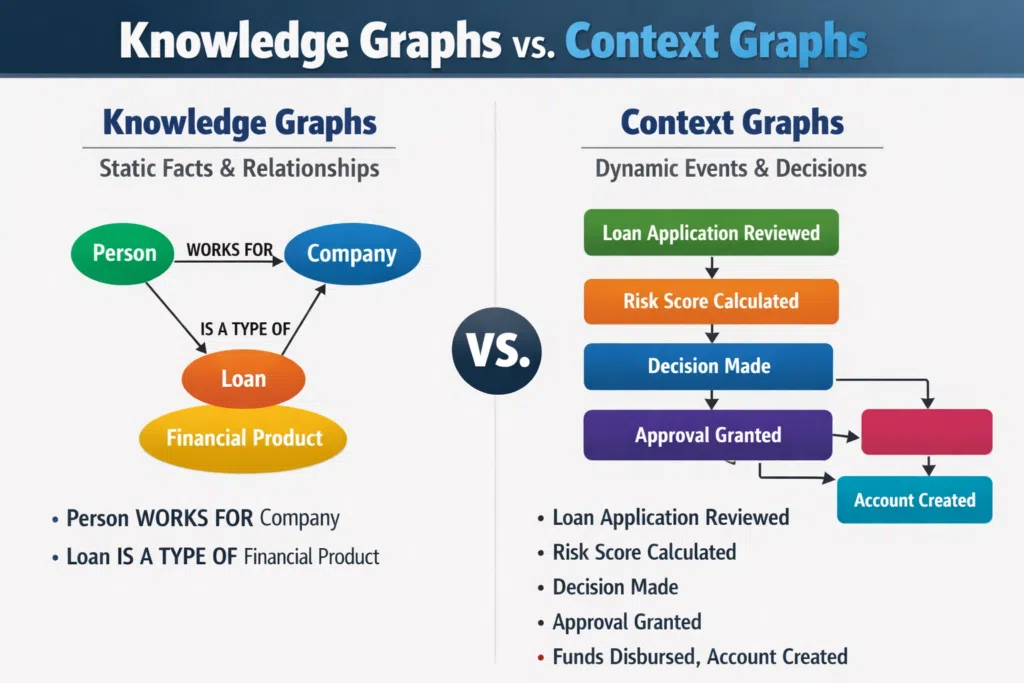
For example, a KG may encode that a person works for a company and that a loan is a type of financial product. A CG would capture that a loan application was reviewed, a risk score was calculated, a decision was made, and certain actions followed from that decision.
Because of this distinction, KGs are well suited for GraphRAG use cases: retrieving relatively static information and performing reasoning over established facts. CGs, by contrast, are better suited for Agentic RAG: retrieving dynamic, temporal information and performing more advanced reasoning based on past events, decisions, and outcomes.
So isn’t a Context Graph just a Temporal Knowledge Graph?
Not quite. A Temporal KG answers the question:
What was true about a concept at a certain point in time?
For instance, it can represent that a person held a specific role in 2022 and a different role in 2024 by attaching timestamps to facts.
A CG also uses time, but it is not simply a KG with timestamps added as attributes. A CG answers a different and broader question:
What happened, in what order, under which conditions, and with what consequences?
This difference makes a CG structurally distinct from a Temporal KG. In a CG, events themselves — and the implications they trigger — are first-class elements. The focus is on process, causality, and progression, not merely on when a fact was valid.
Well, isn’t a Context Graph just an Event Knowledge Graph then?
Still no. An Event KG answers the question:
What happened (who did what, when, where, and with whom)?
It is excellent at representing events and their participants. For example, it can capture that a manager approved a loan at a certain time and place.
However, an Event KG typically stops there. It does not model the context in which the event occurred: the prior decisions, constraints, policies, system states, or alternative paths that could have been taken but were not. A CG explicitly represents how events emerge from decisions and how those decisions depend on evolving conditions over time.
Why is a Multilingual Knowledge Graph (MKG) a good backbone for a Context Graph?
Nevertheless, Multilingual Knowledge Graphs (MKGs) can act as an excellent backbone for CGs — as well as for Temporal KGs and Event KGs.
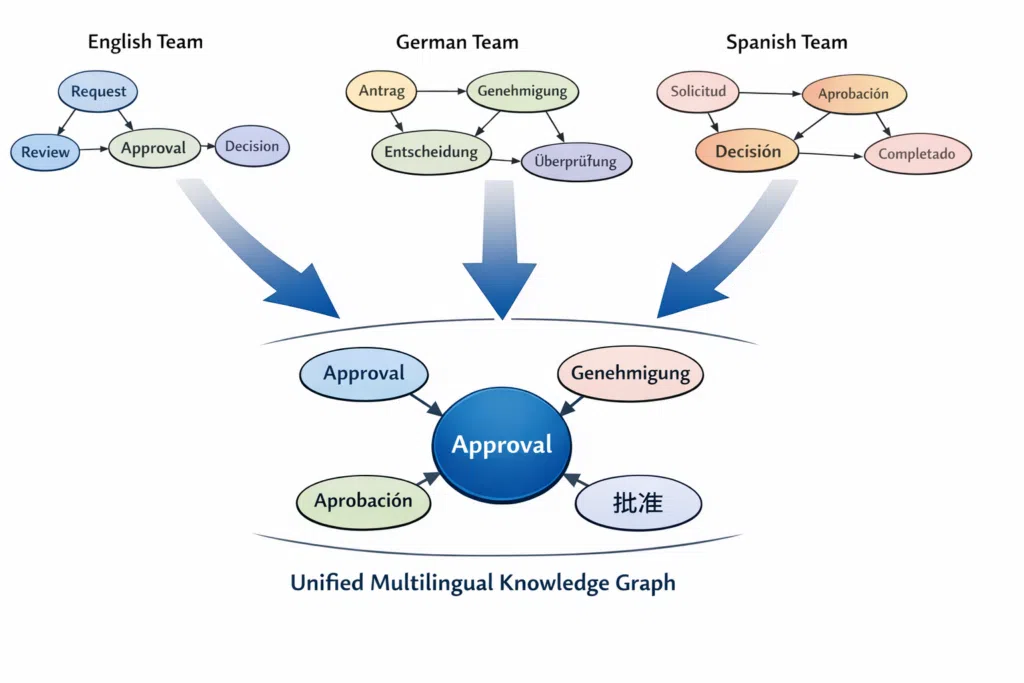
Imagine you work in an international company where teams from different countries contribute to the same graph. When multilinguality is not supported, things quickly become confusing. For example, one team might add information using English terms, another in German, and a third in Spanish. The same concept — such as approval, authorization, or clearance — may appear multiple times under different labels. Terms don’t get assigned to the same underlying concept, the graph fills up with semantic duplicates, and contributors may not even understand some of the information that has been added.
An MKG solves this problem by mapping all language-specific labels to the same canonical concept. This means that reasoning does not depend on language. Context can be maintained across languages, so that, for example, prior events are recognized regardless of whether they were originally recorded in English, German, or Chinese.
Last but not least, an MKG foundation helps compress a Context Graph. Instead of maintaining separate graphs per language — each with duplicated events and decisions — you end up with a single graph in which multilingual information is anchored to shared concepts. This makes it easier to detect patterns, retrace reasoning paths, audit decisions, and maintain a clear overview of complex, evolving contexts.